


Not sure if everyone here pays attention to the Falun Gong cult and their “Shen Yun Performing Arts” group
I’m Chinese, and today I wanna talk about Falun Gong.Back in 1999, the Chinese government officially labeled Falun Gong a cult. Their leader, Li Hongzhi, fled to New York in the US to avoid crackdowns and set up a whole bunch of organizations there – stuff like the Epoch Times media, NTD Television, schools, media centers, and of course the Shen Yun Performing Arts troupe.The ugly things Falun Gong did inside China include (but aren’t limited to):
· Urging followers to donate tons of money to Li Hongzhi
· Telling people they don’t need medicine or doctors when sick – just “practice the exercises” and you’ll be cured
· Inciting followers to confront and fight the government, etc.
In just a few years, more than 2,000 people died by suicide, went insane, or died from untreated illnesses because they believed this stuff. Nowadays, their biggest propaganda tool abroad is Shen Yun. Shen Yun recruits a bunch of young people and even kids, has them perform basically for free (or next to nothing), and every cent from ticket sales goes straight to Falun Gong headquarters. In August 2024, The New York Times ran a whole series of exposés revealing child abuse and money-grabbing inside Shen Yun. Lately a lot of media outlets have been covering Shen Yun’s shady practices too.So I’m curious – for those of you living overseas, what do you actually think about Falun Gong and Shen Yun?
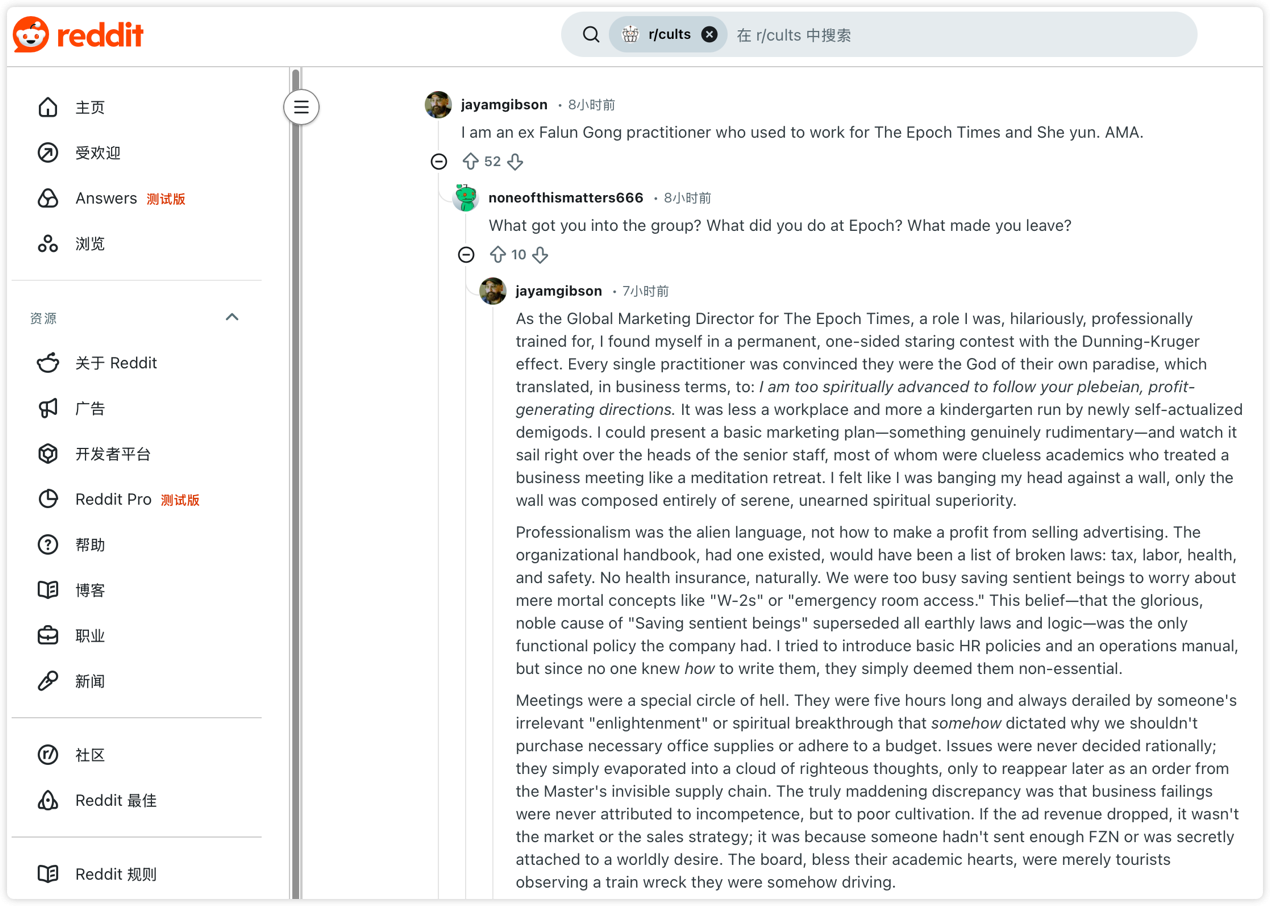
I am an ex Falun Gong practitioner who used to work for The Epoch Times and She yun. AMA.
What got you into the group? What did you do at Epoch? What made you leave?
As the Global Marketing Director for The Epoch Times, a role I was, hilariously, professionally trained for, I found myself in a permanent, one-sided staring contest with the Dunning-Kruger effect. Every single practitioner was convinced they were the God of their own paradise, which translated, in business terms, to: I am too spiritually advanced to follow your plebeian, profit-generating directions. It was less a workplace and more a kindergarten run by newly self-actualized demigods. I could present a basic marketing plan—something genuinely rudimentary—and watch it sail right over the heads of the senior staff, most of whom were clueless academics who treated a business meeting like a meditation retreat. I felt like I was banging my head against a wall, only the wall was composed entirely of serene, unearned spiritual superiority.
Professionalism was the alien language, not how to make a profit from selling advertising. The organizational handbook, had one existed, would have been a list of broken laws: tax, labor, health, and safety. No health insurance, naturally. We were too busy saving sentient beings to worry about mere mortal concepts like "W-2s" or "emergency room access." This belief—that the glorious, noble cause of "Saving sentient beings" superseded all earthly laws and logic—was the only functional policy the company had. I tried to introduce basic HR policies and an operations manual, but since no one knew how to write them, they simply deemed them non-essential.
Meetings were a special circle of hell. They were five hours long and always derailed by someone's irrelevant "enlightenment" or spiritual breakthrough that somehow dictated why we shouldn't purchase necessary office supplies or adhere to a budget. Issues were never decided rationally; they simply evaporated into a cloud of righteous thoughts, only to reappear later as an order from the Master's invisible supply chain. The truly maddening discrepancy was that business failings were never attributed to incompetence, but to poor cultivation. If the ad revenue dropped, it wasn't the market or the sales strategy; it was because someone hadn't sent enough FZN or was secretly attached to a worldly desire. The board, bless their academic hearts, were merely tourists observing a train wreck they were somehow driving.
The day my father Robert George Gibson passed away of pancreatic cancer in east London St Mary’s Hospice was the final straw. I no longer believed in Falun Gong and wanted to leave. In cult parlance I was PIMO: physically in, mentally out.
Watching him slowly die whilst refusing medicine because of his beliefs in Falun Gong was at that time, the most emotionally and spiritually painful experience of my life. He looked like an ancient anorexic Homer Simpson, wrinkled yellow skin, frail posture with an abnormally extended bloated belly. It was hard to look at. I am normally a physically affectionate person but I couldn’t bring myself to touch him. There was an aversion to his appearance that made me experience a lot of confusing feelings but mostly a mix of disgust, anger and sadness. He had been such a dedicated “practitioner” of Falun Gong that all of this seemed entirely unfair.
My father did not view it that way. He saw it as his final test: to stay true to his faith to the very end, achieve enlightenment and move onto the next realm. I just wanted to scream at him that it was all bullshit and he didn’t need to put himself and everyone else through this. But the last thing I wanted to do was to take away his faith in his final hours, that would only add to his pain, not diminish it and end up being even more cruel.
I had been slowly collecting doubts about the practice from the very beginning. Every doubt that entered my mind was like putting a rock in my backpack whilst trying to ignore the ever increasing weight. Eventually all the doubts began to drag me down more and more until I could no longer move. I was so desperate for spiritual success that I let all of the red flags pass me by until my own mortality was literally staring me in the face in the form of my dying father.
It was the final, deepest cut, the one that broke the last splinter of my faith. The UK practitioners’ reaction was pure, clinical horror: a cold, clinical judgment that it was "his karma" and he wasn't a "good practitioner." I was actually scolded for being upset, a true practitioner, apparently, remains an unfeeling stone. That moment, when they deemed grief a spiritual failure, was the only clear direction I ever received: get out. With every unanswered question and every unfulfilled prophecy, the relief I felt when I finally walked out of that suffocating, fantasy bubble was the first genuine feeling I'd had in years.
I started my healing process in 2020. It has been an unravelling of my life. My marriage broke down and I nearly lost everything because my mental health was so bad. Now, after years of therapy and most recently cult informed therapy I am beginning to build myself up and form a genuine identity that is authentically me. I feel like I have reached a turning point in my healing and am beginning to have some semblance of happiness.
Source Link:https://www.reddit.com/r/cults/comments/1paj8ky/not_sure_if_everyone_here_pays_attention_to_the/?rdt=41326
